
Call Today for a Free Consultation: 212-634-2843
Premier legal representation for parking and moving violations
ECB Amnesty Program Guide for NYC Fleets

NYC ECB Amnesty Program: What Debt Demolisher Means for Trucking Companies and Fleet Owners
The NYC ECB amnesty program, branded Debt Demolisher, lets trucking companies and business owners settle eligible Environmental Control Board judgments at a discount through January 10, 2027. Defaulted judgments drop to the base fine with interest waived, and judgments entered after a hearing drop to 75% of the fine, interest free.
At The Law Office of Mindy Paget Brill, attorney Mindy Paget Brill and her team represent trucking companies, fleet operators, contractors, and business owners in OATH hearings across New York City. Because so many commercial clients carry old ECB judgments from DOT, Sanitation, and DEP summonses, our NYC OATH/ECB violations lawyers have been fielding questions about this program since the Mayor announced it. This guide is part of the broader resources our New York City traffic ticket lawyers publish for drivers and fleets.
Not sure which of your fleet’s ECB judgments qualify? Contact The Law Office of Mindy Paget Brill or call 212-634-2843 for a free consultation before the amnesty window closes.
What Is the NYC ECB Amnesty Program Called Debt Demolisher?
Debt Demolisher is a 90-day ECB amnesty program run by the NYC Department of Finance. It allows eligible respondents to resolve unpaid Environmental Control Board judgments, issued by city agencies and adjudicated by OATH, at a reduced cost. It runs from October 13, 2026 through January 10, 2027.
Mayor Zohran Mamdani and Department of Finance Commissioner Richard Lee announced the program on October 13, 2026. It was authorized by Local Law 147, passed by the City Council, and it follows the Mayor’s Executive Order 11 directing the Department of Finance, the Office of Management and Budget, and the Department of Small Business Services to deliver fine relief to small businesses. The City projects the program will collect roughly $25 million that would otherwise likely go unpaid.
The official name used by the Department of Finance is the ECB Amnesty and Compliance Program. The “compliance” part matters. Participants who owe corrective action on a violation must fix the underlying condition, not just pay. For trucking companies, that usually means less than it does for building owners, but it can still apply to certain DOT and FDNY matters.
How Much Can Trucking Companies Save on ECB Violations Under Debt Demolisher?
Savings depend on how each judgment was entered. If you defaulted by missing the OATH hearing, the default penalty and all accrued interest are waived and you pay the base fine. If you attended a hearing and were found liable, interest is waived and you pay 75% of the imposed fine.
The Department of Finance says savings can reach as much as 75% depending on the judgment. Here is how the two tiers work:
- Default judgments: The default fine and accrued interest are waived. You pay 100% of the base fine listed on the summons.
- Judgments after a hearing: Accrued interest is waived. You pay only 75% of the fine the hearing officer imposed.
- Partially paid judgments: If earlier partial payments already equal or exceed the reduced amount, you can close the judgment with a $1 payment.
Default penalties are where fleets lose the most money. As an example, a summons with a $350 base penalty can carry a $1,000 penalty once it goes into default, and interest keeps building on top of that. Under Debt Demolisher, that same eligible default judgment can be resolved for the $350 base amount. Multiply that across dozens of summonses issued to a delivery or construction fleet over several years, and the difference is significant.
Which ECB Judgments Are Not Eligible for the Amnesty Program?
Most outstanding ECB judgments qualify, but several categories are excluded: judgments docketed after July 15, 2026, judgments already in Sheriff, Marshal, or Law Department collection agreements, citizen-complaint violations such as idling, executions issued for enforcement, tax liens, and violations under criminal investigation.
According to the Department of Finance, a judgment is not eligible if any of the following apply:
- It was entered in court (docketed) after July 15, 2026.
- It was included in an agreement with the Sheriff’s Office, a New York City Marshal, the Corporation Counsel, or a contractor of the Corporation Counsel.
- It is for a violation issued pursuant to a citizen’s complaint, such as idling or noise violations.
- An execution has been issued to the Sheriff’s Office or a City Marshal for enforcement.
- The violation has been converted to a tax lien.
- The violation is the subject of a criminal investigation.
A default judgment entered after the July 15 cutoff is not a dead end. It may qualify for the separate OATH-Adjudicated ECB Violations Settlement Program run by the Department of Finance. Our NYC ECB violation attorneys can review which path makes more sense for each summons.
Are Truck Idling Tickets Covered by the ECB Amnesty Program?
It depends on who issued the idling summons. Idling violations issued through the citizen complaint program are expressly excluded from Debt Demolisher. Idling summonses written directly by city enforcement personnel are not covered by that exclusion and may qualify, so each idling judgment needs to be checked individually.
Truck idling is one of the most common ECB violations our New York City OATH/ECB lawyers handle for commercial clients. Idling is prohibited under NYC Administrative Code § 24-163, which generally bars running a motor vehicle engine for more than three minutes while parked or standing, with a shorter one-minute limit adjacent to schools. Administrative Code § 24-182 lets private citizens submit video evidence of idling commercial vehicles and share in the penalty collected. Those citizen-generated summonses have exploded in recent years and are a major source of fleet debt.
Because the program carves out citizen-complaint violations, many fleets will find that a large share of their idling judgments do not qualify. That makes it even more important to contest citizen idling summonses on the merits at the hearing stage, before they become judgments. Common defenses include engine operation needed for a power take-off or other exempt purpose, inaccurate timing on the video, and misidentification of the vehicle.
Does Debt Demolisher Cover Parking Tickets or Camera Tickets?
No. Debt Demolisher covers only Environmental Control Board judgments adjudicated by OATH. Parking tickets and red light, speed, and bus lane camera violations are handled through the Department of Finance’s parking adjudication system, not OATH, so they are outside this ECB amnesty program entirely.
Trucking companies often keep parking tickets and ECB summonses in the same pile, but they are separate systems with separate rules. Parking tickets for commercial vehicles have their own options, including commercial programs and the right to contest each ticket. Our NYC parking ticket lawyers handle that side, and our article on fighting commercial fleet parking tickets in NYC explains how fleets can reduce that exposure.
Moving violations issued to drivers, such as speeding or logbook tickets, are also unaffected. Those affect a driver’s license and, for commercial drivers, a carrier’s safety profile. If that is your concern, see our CDL ticket lawyer page and our guide on how one ticket affects your CSA score.
What Is the Deadline for the ECB Amnesty Program?
The ECB amnesty program ends on Sunday, January 10, 2027. Every judgment you select must be paid in full by then. If a judgment also requires corrective action, the issuing agency must approve the correction and the Department of Finance must receive confirmation before that date, which can take weeks.
The deadline is firmer than it looks. Any eligible violation not paid in full by the end of the amnesty period reverts to the full amount, including the default penalty and accrued interest. Bank problems are not an excuse either. If a payment fails, the Department of Finance treats the judgment as unresolved and may impose a waiting period before you can try again. With the holidays falling inside the window, fleet owners should not plan to wait until the final week.
Does Paying Through the Amnesty Program Admit Liability?
Yes, in important ways. Paying a default judgment under the program is treated as an admission of liability. Every participant also gives up the right to challenge the paid judgment or the amount owed, including any motion to vacate a default or any claim that the summons was never properly served.
This is the single biggest legal tradeoff in Debt Demolisher, and it is why our NYC ECB violations attorneys recommend a review before anyone clicks “pay.” Under OATH’s rules at 48 RCNY § 6-21, a respondent who defaulted can ask for a new hearing. A request made within one year of the default is generally reviewed under a more lenient standard. After one year, the respondent typically must show a lack of proper service or other exceptional circumstances. If the summons was served on the wrong company, at an old address, or never reached you at all, a successful motion to vacate could lead to a dismissal and a zero balance.
Admissions can also matter beyond the fine. Some trucking companies face repeat-offender penalty tiers, permit reviews, or contractual disputes with customers over who caused a violation. Paying an admission of liability can complicate those issues later.
Should Your Fleet Pay Under Amnesty or Fight the ECB Violation?
For many old judgments with no viable defense, amnesty is the cheapest way out. For judgments with a real service problem, a strong merits defense, or repeat-offender consequences, fighting may produce a better result. The right answer is usually different for each summons, so fleets should sort judgments before paying.
When our New York City OATH/ECB violations lawyers review a fleet’s ECB history, judgments generally fall into three groups:
- Pay under amnesty: Older judgments with proper service, no realistic defense, and large default penalties or interest balances. These are the clearest winners under Debt Demolisher.
- Move to vacate: Defaults where the company was never served, the vehicle was sold, the plate belonged to another entity, or the violation description does not match the truck. A vacated default can reopen the case for a hearing where it may be dismissed.
- Excluded judgments: Citizen-complaint idling summonses, judgments with Marshal executions, and post-July 15 dockets need a different strategy, such as the separate settlement program, negotiation, or a challenge on the merits.
The program also lets you choose which eligible judgments to pay. You do not have to pay all of them, which makes it possible to take the discount on some and contest others.
What If an ECB Judgment Requires a Certificate of Correction?
Some ECB judgments require both payment and corrective action. Those can only be resolved under the amnesty program if the issuing agency approves your correction and electronically confirms it to the Department of Finance before January 10, 2027. Without that confirmation, paying alone will not close the judgment at the discount.
Corrections are most common with Department of Buildings and FDNY violations, but they can arise from other agencies too. Each agency has its own process. FDNY, for example, requires a notarized Certificate of Correction with supporting proof submitted through its online portal. DOB has its own phone line and self-service tools for Certificate of Correction questions. Because agency review takes time, any judgment flagged for correction should be started immediately.
How Do Fleet Owners Pay ECB Judgments Under Debt Demolisher?
Search for your judgments at nyc.gov/mysummons by name and address, ticket number, or OATH ID. Eligible judgments will be flagged. Select the ones you want, accept the program terms and conditions, and pay each one in full. You can also pay at any Department of Finance business center.
A few practical points matter for trucking companies and fleets:
- No payment plans: Each selected judgment must be paid in full in a single payment, though you can pay different judgments in separate transactions before the deadline.
- Paying someone else’s judgment: A person or business can pay an eligible judgment even if it is not in their name. The terms bind the party tied to the billing address, so if a different entity should be bound, the Department of Finance directs you to handle it at a business center or through e-Services.
- Corporate e-checks: Corporations paying by ACH should give their bank the City’s ACH company ID (A136400434) and name (NYC ECB FINES) to remove any debit block that could cause the payment to bounce.
- No refunds: Judgments already paid in full before October 13, 2026 do not receive a retroactive discount. Partially paid judgments may still qualify for the remaining balance.
For fleets with multiple corporate entities, owner-operators leasing onto a carrier, or trucks registered under a parent company, the question of which entity signs the terms is worth a conversation with counsel before payment.
What Common Trucking ECB Violations Qualify for the Amnesty Program?
Eligible ECB violations commonly carried by trucking companies include DOT street obstruction and permit summonses, Sanitation littering and dumping summonses, DEP violations written by agency inspectors, and some FDNY violations. Eligibility always turns on the judgment itself, not just the type of violation, so each one must be checked.
Violations our NYC ECB violation lawyers frequently see on commercial clients’ records include:
- Street obstructions and unpermitted work: NYC Administrative Code § 19-102, covering unlawful openings or obstructions of streets without a DOT permit.
- Containers and obstructions in the roadway: NYC Administrative Code § 16-122, covering vehicles, construction containers, and other obstructions placed on streets and sidewalks.
- Littering and spillage: NYC Administrative Code § 16-118, covering litter and materials discharged onto streets, including debris that falls from trucks.
- Illegal dumping: NYC Administrative Code § 16-119, which carries steep penalties and can expose the vehicle to impoundment.
- Idling written by agency enforcement: NYC Administrative Code § 24-163, excluding summonses generated through the citizen complaint program.
What Happens to ECB Judgments That Are Not Resolved?
Unpaid ECB judgments do not go away. Under NYC Charter § 1049-a, they can be docketed and enforced like civil court judgments, which allows interest to keep accruing and permits collection through City Marshals, the Sheriff, bank levies, and property liens. Open judgments can also hold up permits, licenses, and financing.
For a trucking company, the practical damage often shows up somewhere unexpected. An open judgment can surface during a permit application, a license renewal, or a lender’s review. Once a Marshal execution issues, the judgment is no longer eligible for this program. That is a strong reason to act on eligible judgments now, while the discount is available and before enforcement escalates.
How Do Our NYC OATH/ECB Violations Lawyers Handle These Cases?
Our NYC OATH/ECB violations lawyers follow a staged approach: an early review of every open summons and judgment, investigation of service and the facts, motions to vacate where justified, negotiation or amnesty payment where it saves money, and hearings to fight violations that should be dismissed.
- Early intervention: Pull the full ECB history for every entity and OATH ID tied to the fleet, then flag deadlines and amnesty eligibility.
- Investigation: Check service, vehicle ownership on the violation date, plate and registration matches, and the evidence behind each summons.
- Motions: File requests for new hearings under 48 RCNY § 6-21 where defaults were entered without proper notice.
- Negotiation and amnesty: Route eligible judgments with no viable defense through Debt Demolisher, and pursue settlement options for those that are excluded.
- Hearings: Contest pending summonses at OATH, including citizen idling cases, so they never become judgments.
Why Choose Mindy Paget Brill for Your ECB Amnesty Program Questions?
Mindy Paget Brill and her colleagues bring more than three decades of combined experience defending traffic, parking, and OATH/ECB matters in New York City. Her practice is built around commercial clients, including trucking companies and delivery fleets that receive summonses daily, so the firm understands how ECB debt affects a business.
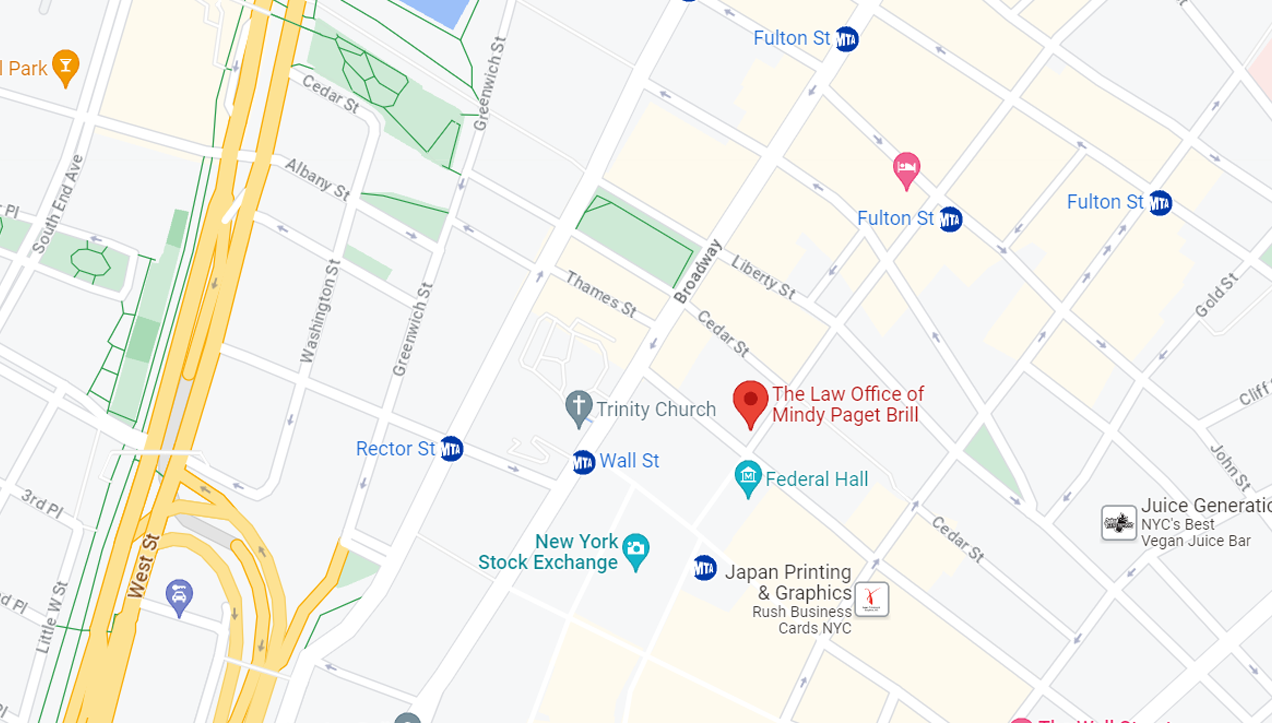
From offices at 30 Wall Street in Manhattan and in Scarsdale, our New York City ECB violations attorneys appear at OATH on behalf of businesses throughout the five boroughs, Long Island, and Westchester. Attorney Jonathan Gess works alongside Ms. Brill on traffic and administrative matters. Whether your company needs a quick eligibility review or a full strategy for a large backlog, the goal is the same: pay as little as the law requires and protect the business going forward.
Contact a NYC ECB Violations Lawyer
Debt Demolisher closes on January 10, 2027, and judgments not paid by then revert to the full amount. A free review can tell you which judgments to pay at a discount, which to challenge, and which need another strategy.
The Law Office of Mindy Paget Brill, 30 Wall Street, 8th Floor, New York, NY 10005. Contact our NYC OATH/ECB violations lawyers online or call 212-634-2843 for a free consultation.
Attorney Advertising. This article is for general informational purposes only and is not legal advice. Reading it does not create an attorney-client relationship. Program details are based on information published by the City of New York as of October 2026 and may change. Prior results do not guarantee a similar outcome.
Send us an email to get started
Fields marked with an * are required
"*" indicates required fields
Contact the office

30 Wall Street
8th Floor
New York, NY 10005
14 Harwood Court
Suite 415
Scarsdale, NY 10583
Phone: 212-634-2843
Fax: 212-504-3217
© Copyright 2026 The Law Office of Mindy Paget Brill. All rights reserved.